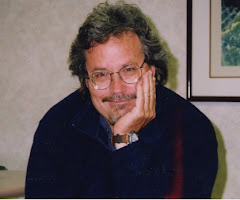
You see, I'm new to this blog game. I've been tagged, I'm told, by Lutheran Lucciola, the brat. She has in turn been tagged by The Elephant Child--a more interesting blog name I haven't run across. I gather one is to confess to the world--the small world that comes across one's blog (small indeed!)--seven things about oneself which one claims to be...."true". But, what is truth? Let's see what I can conjure up...
1. I met my wife at Phase One of Teacher Training in northern California. We were in training to become Transcendental Meditation teachers; spent the summer doing a lot of meditation, eating veggies, and listening to lectures by Captain Video aka Maharishi Mahesh Yogi till we were stupified with transcendence.
2. We're in our 19th year of homeschooling. As principal, I principally loom in the doorway on occasion.
3. I continue to hold the record at Ski Hi Apple Farm for the Most Apples Picked In One Day. Something in the 170 bushel vicinity. Most of the people who witnessed the event are dead, but the record lives on. Immortality!!
4. As far as being a savvy businessman goes,, I'm a really good lawn mower.
5. Baptized by my grandfather. I was there, I guess.
6. I became a Lutheran, I kid you not, because it was the closest church to my house.
7. I was once a member of the World Champion Four-Man Watermelon Seed Spitting Team. Pardeeville, WI, September 1984.
They say that confession is good for the soul but bad for the reputation. But I feel GOOD, you know! Now, I pass the baton to: Mental Llama, Once A Fool Always A Fool, and Ed Veith's Cranach Blog, if I can get them to respond.
Wednesday, October 17, 2007


Tuesday, October 16, 2007
Idols and Vocation


"Little children, guard yourselves from idols". This, the last words of St. John's first epistle, is loaded language.
It came to mind when I was hired to make a shelf for a client. It was to hang from the wall, but not have any visible means of hanging: no brackets or attachment hardware. As fun as it was to design and make, it did bring me up short when I found its purpose was to hold a statue of Kuan Yin, the Buddhist goddess of compassion.
My wife said, "Ooh, nice shelf! Put some flowers on it!"
I thought pretty much the same, and have deeply mixed feelings about having made this. On one hand, it is just a shelf, and once it changes hands it is of no consequence to me what it is used for.
On the other, it has such a look of altar. I am loathe to promote the worship of a false god, and yet here it is.
A Christian in vocation is called to serve neighbor, defined as anyone God puts in one's way. But I wonder: would it have been more truly service to refuse the work, once its purpose was clear?
What do you think?
Monday, October 8, 2007
Timothy McVeigh and The Afterlife
HT: Get ReligionHow great are Your works, O Lord!
Your thoughts are very deep.
A senseless man has no knowledge,
Nor does a stupid man understand this:
That when the wicked sprouted up like grass
and all who did iniquity flourished,
It was only that they might be destroyed forevermore.Ps. 94: 5-7
A senseless man has no knowledge about the Lord.
One characteristic of a senseless man may be the magnified opinion he has about himself. God is minimized, doubted, derided, scoffed at; the accoutrements of heaven and hell are likewise denied. But having scaled heaven, and finding a throne for his fanny, the stupid man sits down to judge for himself.
A couple of writers have published a book about interviews they did with that scofflaw McVeigh, the bomber. Here is a snippet of interview:
Question from chat room: Does McVeigh have any spiritual-religious beliefs?
Lou Michel: McVeigh is agnostic. He doesn't believe in God, but he won't rule out the possibility. I asked him, "What if there is a heaven and hell?"
He said that once he crosses over the line from life to death, if there is something on the other side, he will -- and this is using his military jargon -- "adapt, improvise, and overcome." Death to him is all part of the adventure.
There isn't much doubt what he thinks about the adventure now. Try "adapting, improvising, and overcoming" when in the hands of the living God.
Saturday, October 6, 2007
"The Demands of Being an American Congregation"

The quote is from the response to the New Orleans House of Bishops' Statement (by American Episcopalian Bishops) which in turn is in response to demands from the southern Primates that the Americans make a definitive statement regarding blessing same-sex unions and other shenanigans. Whew. Here is a bit longer quote, for context:
"...the demands of being an American denomination triumphed over the disciplines of belonging to the Church Catholic."
The demands of being an American congregation. What does this mean?
In the case of TEC, it means they have generously opened their gates to ideas and practices that do not correspond or agree with their own orthodoxy. It has gotten to the point where you can read quotes such as this coming from leaders in TEC:
(This from Elizabeth Kaeton, an official of the Episcopal diocese of Neward, NJ.)
"If Christ Jesus wasn’t crucified because he was being true to his authentic self, so that we, like him, might be able to live our lives with integrity, then I have completely misunderstood the message of Jesus and I have no right to call myself a Christian, much less an Episcopalian in the Anglican tradition. "
The demands of being an American congregation mean something in Lutheranism as well. While conservative Lutheran synods are not as far down the road as ELCA, for example, the challenges to our orthodoxy remain, mostly from neo-evangelical, praise-based worship practices (rather than from peace and justice issues). Is there a relationship between the kind of off-the-wall, unorthodox theology and practice apparently found in many Episcopalian churches and what confessional Lutheran conregations face? In other words, is the same spirit at work in both? Unchecked, is it likely that the confessional Lutheran churches of today already hold the seeds of like apostasy? Are we on the same continuum?
I don't know. But I know a pastor who for some time has been predicting that in his lifetime confessing Lutherans would be forced out of their church buildings and into their homes to worship. Secretly.
Whaddaya think?
Tuesday, October 2, 2007
Anti-Natalism & Reality

"Most people believe that they were either benefited or at least not harmed by being brought into existence. Thus, if they ever do reflect on whether they should bring others into existence--rather than having children without even thinking about whether they should--they presume that they do them no harm. Better Never to Have Been challenges these assumptions. David Benatar argues that coming into existence is always a serious harm. Although the good things in one's life make one's life go better than it otherwise would have gone, one could not have been deprived by their absence if one had not existed. Those who never exist cannot be deprived. However, by coming into existence one does suffer quite serious harms that could not have befallen one had one not come into existence."From Oxford University Press description.
Are you overestimating the quality of your life? Probably. Which is why David Benatar thinks you ought to reexamine whether you should have been born in the first place. He thinks most humans probably should never have been born. This is the only way to, er, "...solve many conundrums of moral theory about population..." If you know anything at all, Peter Singer, you know that resolving contradictions in moral theories is more important than life itself.
Who said ideas have no consequences? What I like about these people--utilitarians all--is how they are honest in their extrapolations. Instead of that famous military aphorism, "Kill 'em all; let God sort 'em out!", we have a pithy philosophy summed up by: "The end justifies the means". God plays no part, as He is just a manifestation of someone's desire to be happy. Or to be justified; same difference. House, M.D. is only the latest, greatest expression of utilitarianism, and his appeal is simply in his blunt honesty--social mores be damned. This is all well and good until someone's honesty results in you being chosen for elimination. These people must love Survivor.
The photo is of Jeremy Bentham, famous Utilitarian who had his body embalmed and is on display at University College London. He is one of a long line of idealists--among them episcopalians, feminists, democrats, Millists, free-thinkers, utopians, Princetonians, Deweyites--who believe that with just enough education, people would be more likely to decide and vote progressively on the basis of rational
self-promotion. Alas, it never works out that way. Backward, Bible-informed moral values just keep intruding into people's lives, and progress is ever something yearned for, but never achieved. Well, except in the Soviet Union, for awhile.
HT to Mercatornet.
Monday, October 1, 2007
WHY I LOVE FLANNERY O'CONNOR

Well, more than this, really. Yet here is a quote that is pure O'Connor, and describes her fiction writing very well:
"[The Christian fiction writer] is entirely free to observe. He feels no call to take on the duties of God or to create a new universe. He feels perfectly free to look at the one we already have and to show exactly what he sees. He feels no need to apologize for the ways of God to man or to avoid looking at the ways of man to God. For him, to ‘tidy up reality’ is certainly to succumb to the sin of pride."
This is taken from an "interview" Marvin Olasky of World Magazine does with one of O'Connor's books. Flannery O'Connor would be in her eighties if she were alive today, and probably scolding and shocking us as much now as she did then. If the above quote doesn't describe any Christian writer you've ever read, you ought to check out O'Connor. A Good Man Is Hard to Find would be a good start. Just don't go looking for any apologies, heheheh!
.
Saturday, September 29, 2007
THE UNINVITED GUEST

Our Thursday night book club wasn't completely without sanctification. I don't mean to mislead. Certainly we were blessed with a feast of KFC chicken, with all the trimmings. Thanks again, Mike! Share those calories, I say.
We also mined a few nuggets from the Wingren book we're currently, um, reading. Most of us. Some of it. Robin claims I haven't gotten her her own copy of the book. What's YOUR excuse?
But I wax lawful. And speaking of the Law: a quote from LUTHER ON VOCATION: Actually, it is Wingren quoting Runestam regarding Luther's understanding of the second application of the law:
"...It is in the conscience that the law is to fulfil its most important role, its usus theollogicus seu Spiritualis (theological and spiritual use), the awakening of sin. It is in the conscience after all that the law is to operate--and thereby effect a good work--in the conscience where it is the uninvited guest." P. 60
Lutherans like to talk about "terrified consciences", as though we stagger into church each week burdened beyond speech. I rather think we collect sin throughout the week like lint, and only are peripherally aware of the burden we bear. And therefore, when our sins are forgiven us, we may only peripherally appreciate the fact of it. Only rarely do we spend a night in terror at our deeds or lack of deeds.
Nevertheless, we do not naturally invite the law into our conscience. It truly is an uninvited guest, soiling our linens and drinking our best wine. WE try to purchase a clean conscience. We try to outwork the law. Or to ignore it. Trying to ignore or appease an unsettled conscience may be mankind's main historic activity: failing to gain a secure conscience by our actions or our philosophies, we try to ignore a soiled conscience by our actions, money, or philosophy.
Think of how rare access to Christ's forgiveness has been for generation upon generation. Rare, due to unbelief. Rare, due to lack of knowledge, because it wasn't understood as being possible or available. For how many millions of people has there been no one to say to them: "I forgive your sins in the name of the Father, and the Son, and the Holy Spirit" ? Think how the absence of forgiveness has formed cultures and civilizations.
In THE QUEST FOR HOLINESS by Koberle, man's attempts to storm heaven, to "sanctify himself in God's sight" is described at length:
"The sanctification of conduct by the strengthening of the will; the sanctification of the emotions by a strenuous training of the soul; the sanctification of thought by a deepening of the understanding; moralism, mysticism, speculation, these are the three ladders on which men continually seek to climb up to God..." P 2.But what else could the world do? What else would YOU do? The plain, simple, obvious answer is too plain, too simple and not obvious at all.
Subscribe to:
Posts (Atom)